
Quantum Readiness Report Germany
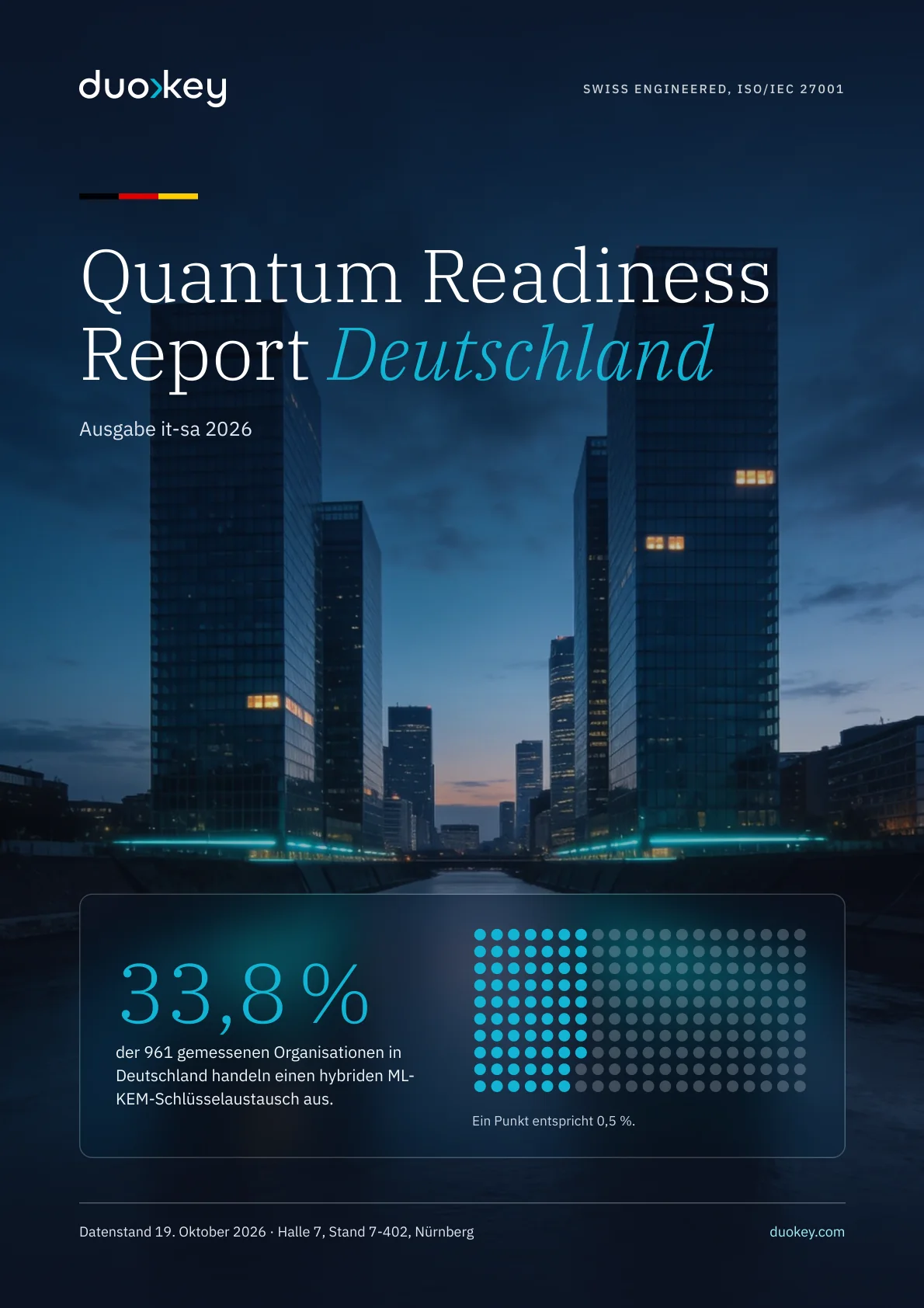
it-sa 2026 edition. 25 pages, in German. Data as of 19 October 2026.
A measurement of 961 German organisations in the 16 NIS2 sectors, based on what their public servers negotiate. 33.8 percent already use a hybrid post-quantum key exchange. The report breaks this down by sector, compares Germany with ten European countries, and ends with a 90-day plan. Download it to see where your sector stands against its peers, and to take a citable baseline into your next board or NIS2 discussion.
Get the download
Tell us where to send the link. A business email is required.
One in three German organisations already protects its traffic against tomorrow's quantum computers. The other two are still sending data that can be recorded today and decrypted later.
Digital services are the furthest ahead. Banks and postal services are the furthest behind. Where does your sector sit, and how does Germany compare with its neighbours?
The figures are fixed at 19 October 2026. The live scan keeps moving, so this PDF gives you a stable record to cite in board papers, NIS2 reporting, or budget requests. Download it, find your sector's table, and start with the 90-day plan at the end.
FAQ
What is in the report?
The score distribution for all 961 organisations, a table for each of the 16 NIS2 sectors, Germany compared with ten European countries, the 2026, 2030, and 2035 deadlines, and a 90-day plan.
Is it in English?
No. This edition is in German only.
Is my organisation named?
No. All figures are aggregated. No organisation is named.
How was it measured?
From outside, by recording which key exchange public servers negotiate. Nobody was surveyed and no internal access was used. It shows what is visible from the internet, and it is not an audit.
Why does hybrid key exchange matter?
It combines a classical algorithm (X25519) with a post-quantum one (ML-KEM). Traffic recorded today stays protected even if one of the two is broken later. BSI recommends this approach.