
QRS
A deterministic score against an auditable methodology
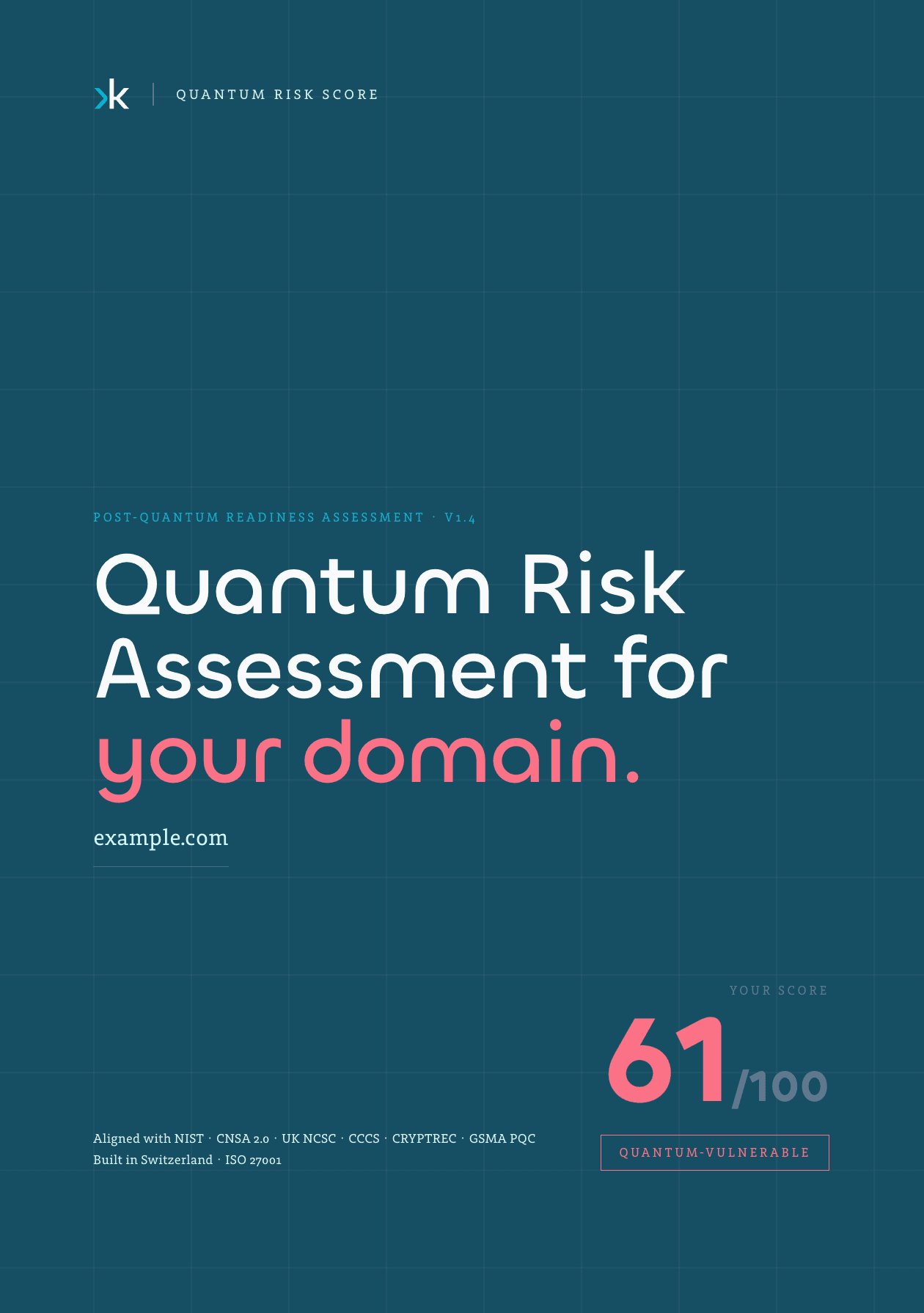
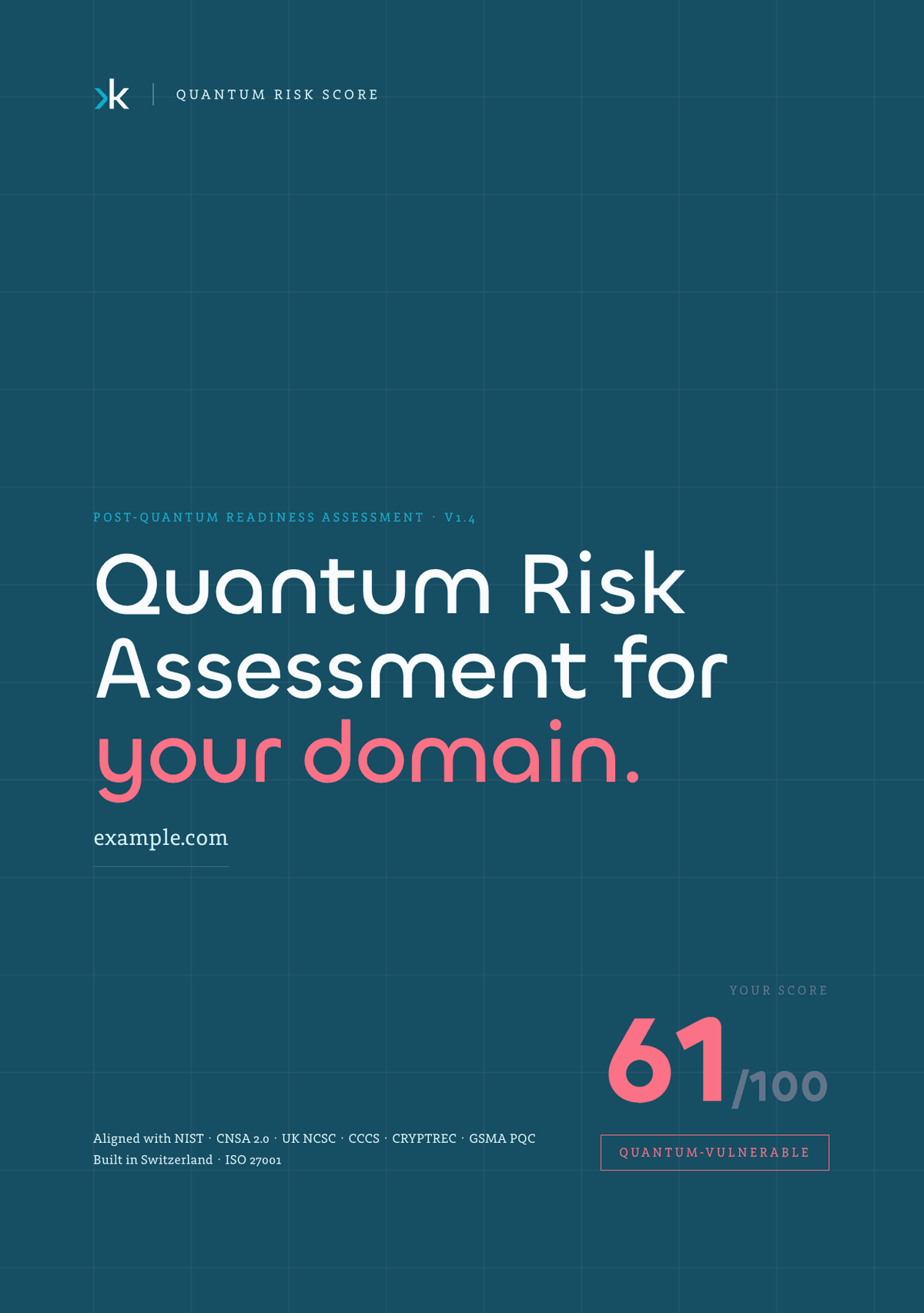
The Quantum Risk Score (QRS) evaluates the cryptographic posture of an organisation's observable domain surface against post-quantum migration standards. The composite index (scored 0 to 100) is derived from four signals with explicit, published weightings. No proprietary components; the methodology is fully reproducible by any qualified cryptographer. The assessment operates exclusively on publicly observable signals and does not require access to internal systems.
Product demo
Watch the Quantum Risk Score demo
Scan any domain, then see your score, severity and quantum exposure.
Regulatory timeline
Migration timelines are fixed. Preparation is not.
2027
CNSA 2.0 mandate
NSA-mandated PQC for all new national-security systems by January. Organisations that miss this deadline face non-compliance with US federal security requirements.
2030
NIST IR 8547
RSA-2048 and ECDSA P-256 officially deprecated. Continued use after this date will fail FIPS compliance validation.
<1M
physical qubits · ~1,700 logical
Current research estimates
Physical-qubit estimates to factor RSA-2048 have decreased from 20M (Gidney & Ekerå 2019) to under 1M (Gidney 2025). The logical-qubit count now stands at approximately 1,700 (Chevignard, Fouque, Schrottenloher 2024).
Methodology
Four signals, explicit weightings, no proprietary components.
QRS = (Algorithm resilience × 0.40)
+ (Crypto agility × 0.30)
+ (Harvest exposure × 0.20)
+ (Migration posture × 0.10)
Algorithm resilience
Asymmetric primitives and symmetric cipher suites in production, measured against FIPS 203 (ML-KEM), FIPS 204 (ML-DSA) and FIPS 205 (SLH-DSA). RSA-2048 and ECDSA P-256 score zero under NIST IR 8547 criteria.
Crypto agility
Capacity to transition algorithms without redeployment: TLS 1.3 adoption, hybrid cipher suite support, certificate rotation cadence, algorithm diversity, CAA configuration and DNSSEC algorithm.
Harvest exposure
Data at risk under harvest-now-decrypt-later threat models, weighted by data lifespan, forward-secrecy posture and the classification of endpoints transmitting long-retention data.
Migration posture
Public evidence of an active quantum-readiness programme: a published Cryptographic Bill of Materials, hybrid endpoint testing and vendor quantum-readiness disclosures.
Score interpretation
Four readiness levels
0-39
Low readinessHigh HNDL exposure
RSA-2048 and ECDSA dominant throughout. No hybrid cipher support detected. Long-retention data exposed to harvest-now-decrypt-later. Non-compliant with CNSA 2.0 for US NSS-adjacent deployments.
40-69
Early readinessModerate HNDL exposure
Modern TLS in use, but exclusively classical algorithms. No migration plan identified from public signals. Representative of most enterprise deployments observed in 2025.
70-89
Developing readiness
Classical and PQC cipher suites operating in parallel. Crypto-agile architecture demonstrable. CBOM published. Migration path documented against at least one regulatory timeline.
90-100
Advanced readiness
PQC-native by architecture. Crypto-agility validated. Continuous CBOM monitoring in place. Tracking NIST IR 8547 and CNSA 2.0 deprecation schedules operationally.
Deliverables
A comprehensive, actionable report
- 01Executive summary
A single board-ready page. Composite score, readiness band and top-three findings. No reformatting required for governance reporting.
- 02Cryptographic inventory
Full enumeration of observed endpoints, certificates, signature algorithms and DNSSEC configuration across the assessed domain.
- 03PQ migration priority matrix
Quantum-vulnerable assets ordered by migration urgency, a ranking adapted to cryptographic obsolescence rather than exploitability.
- 04Regulatory timeline mapping
Assessed posture mapped against NIST IR 8547, CNSA 2.0, NCSC, ANSSI and BSI migration deadlines, with a gap analysis by jurisdiction.
- 0536-month migration sequence
Three-phase plan: inventory and classification, structural algorithm transitions, full PQC retirement of legacy primitives.
- 06Review session
A structured walkthrough of findings with the cryptographer who conducted the assessment and signed the report.
RSA-2048
75%
ECDSA P-256
25%
PQC adoption
0%
Forward secrecy
100%
AEAD layer
AES-128
DNSSEC
Off
A migration from RSA to ML-KEM is a necessary correction. An architecture capable of absorbing the next transition is a strategic investment.
DuoKey delivers the algorithmic uplift required by your compliance programme and the structural agility to remain current through successive NIST deprecation cycles.
Certification
ISO/IEC 27001:2022, recertified 2024
Deployments
30+ enterprises across automotive, Swiss banks, EU telcos
Recognition
InCyber Forum 2024, Growth Startup Award
Standards
CycloneDX, SPDX, OWASP-aligned
Engagement
Request a Quantum Risk Assessment
Scope is limited to publicly observable signals. No access to internal systems is required. Includes a full report and a 30-minute review session.
Start a free assessment