PHP2Shell in October, Java4Shell in November: twice within a few weeks, flaws became public that let an attacker run code on a server without signing in. They do not affect exotic systems, but the runtimes that self-hosted file and collaboration platforms run on.
Patching is mandatory. This article asks a second question: what could an attacker have read on your file server before the patch?
Table of Contents
- Two flaws in two months
- What code execution on the server means
- Patching is necessary, but it comes too late
- Documents the server cannot read
- What this means for Nextcloud, openDesk and OpenCloud
- Checklist for the coming days
- Sources
Two flaws in two months
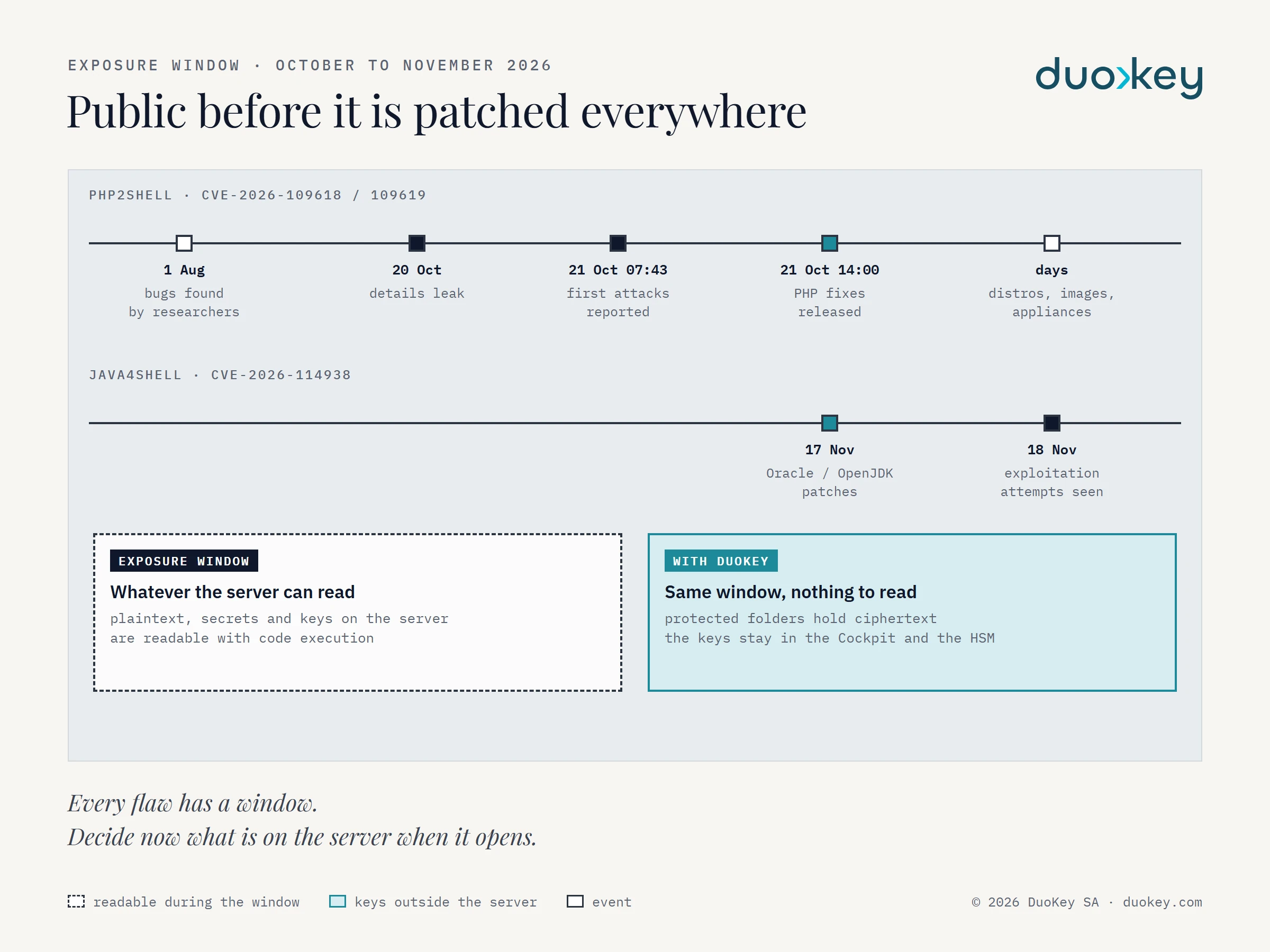
PHP2Shell combines two bugs in the PHP core, CVE-2026-109618 and CVE-2026-109619, both rated 9.2 under CVSS 4.0. They are use-after-free bugs present since PHP 5.4; Apache with mod_php and PHP-FPM are affected. PHP released versions 8.2.35, 8.3.36, 8.4.27 and 8.5.12 on 21 October 2026. Details had leaked the day before, and Cloudflare reported first attacks on the morning of 21 October, before the patches. The researchers behind the tool report code execution without login against, among others, Nextcloud 35.0.1 [1]. An attack needs specific conditions on the target, but the faulty code is in the default configuration [1][2].
Java4Shell (CVE-2026-114938) is a memory bug in the Base64 decoder of the OpenJDK Java runtime, in the 17, 21, 25 and 27 release lines. Servers with x86-64 processors that support AVX-512 VBMI are affected. The researchers showed pre-login execution in default configurations of Keycloak, Jira, Confluence, Artifactory, Jenkins and PingFederate. Oracle and OpenJDK released patches on 17 November 2026; exploitation attempts were observed, and no successful exploitation had been confirmed as of 18 November [3].
Keycloak is the identity provider of many sovereign workplaces, openDesk included. Nextcloud runs on PHP. Both flaws hit exactly the building blocks organizations rely on when they leave Microsoft 365 or Google Workspace.
What code execution on the server means
Whoever runs code on the server of a file platform works with that service's rights. They see what the service sees:
- the data directory with every file of every user,
- the configuration with database credentials and secrets,
- with server-side encryption, the keys too, because they sit on the same server so that it can decrypt.
An access check in the application no longer helps: the attacker does not ask the application, they read the files directly. At that moment, self-hosted only means the leak comes from your own data centre.
Patching is necessary, but it comes too late
With PHP2Shell, hours, not weeks, separated the leak of the details from the first reported attacks. With Java4Shell, runtimes are embedded in many products; it takes days until every distribution, container image and appliance is updated. Add the window before disclosure, when a flaw is known to only a few.
Patching closes the door. It does not tell you what was read in the meantime, and it does not prevent the next flaw. So every risk analysis needs a second question: what is readable on the server once it is compromised?
Documents the server cannot read
DuoKey SecureFolder's answer is to take the key out of the server:
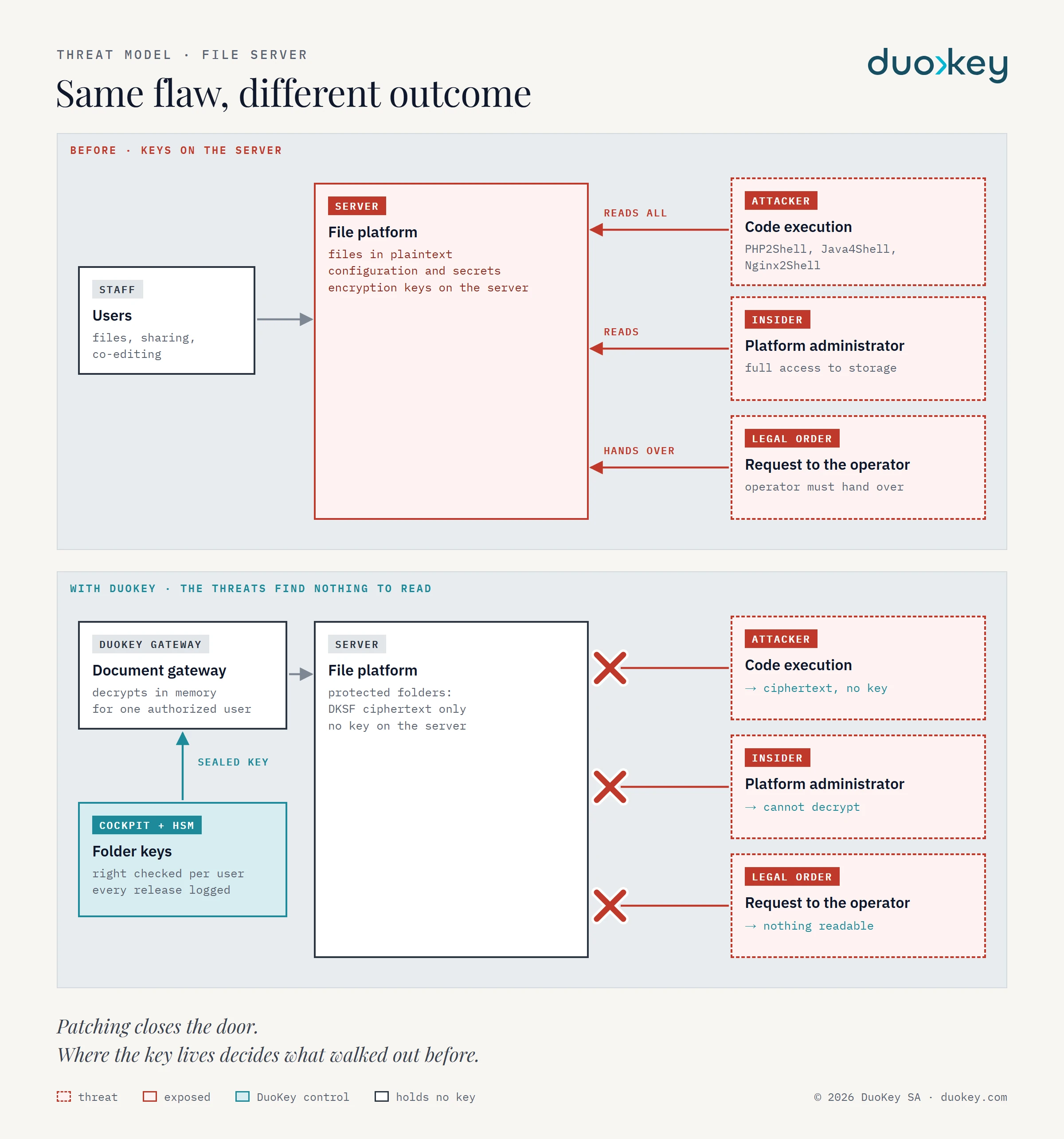
- Documents in protected folders are stored on the platform as DKSF ciphertext only.
- The master key (KEK) sits in your organization's HSM or vault, managed in the DuoKey Cockpit, not on the file server.
- A folder key is released only for an authorized person, sealed with hybrid P-256 and ML-KEM-768, and only to the DuoKey gateway, which decrypts the document in memory for editing.
- Every release and every refusal is in the access journal.
An attacker who takes over the file server finds ciphertext and no key in protected folders. They can delete or encrypt files, so backups remain necessary. They cannot read them. And because every key release is logged, you see who received which folder key and when.
The gateway itself is a narrow component written in Rust, with no PHP and no Java, run separately from the platform. It keeps no keys in stock; plaintext exists only in memory while a document is being edited.
What this means for Nextcloud, openDesk and OpenCloud
- Nextcloud and openDesk: file storage runs on PHP and was affected by PHP2Shell. With SecureFolder, protected folders are stored encrypted in Nextcloud, the keys stay in the Cockpit, and teams keep co-editing in Collabora Online.
- OpenCloud: OpenCloud is written in Go and is not affected by PHP2Shell. The lesson still applies to every platform and every future flaw. With Secure OpenCloud, OpenCloud stores only ciphertext in project spaces.
- The identity provider: Keycloak was affected by Java4Shell. Whoever takes over the identity provider can sign in as anyone. That is why the DuoKey Cockpit checks the right to the key independently of the platform, and a folder key can be revoked in the Cockpit at once.
Checklist for the coming days
- Update PHP to 8.2.35, 8.3.36, 8.4.27 or 8.5.12 (or your distribution's backport) and restart every PHP worker.
- Update Java runtimes to the 17 November builds, including runtimes embedded in Keycloak, container images and appliances.
- Check the file platform's logs for unusual uploads, new apps and outbound connections since 20 October.
- Rotate secrets that were on a possibly affected server: database passwords, app tokens, server-side encryption keys.
- Find out which documents on your servers are readable in plaintext today, and take the keys of the confidential ones out of the server.
For the last point, you can test Secure OpenCloud or SecureFolder with us in your own environment.
Sources
- Sansec, PHP2Shell: PHP RCE (CVE-2026-109618, CVE-2026-109619), 21 October 2026. sansec.io
- Help Net Security, New PHP2Shell scanner checks your hosts for CVE-2026-109618 and CVE-2026-109619, 22 October 2026. helpnetsecurity.com
- Tenable, Java4Shell (CVE-2026-114938): OpenJDK RCE Vulnerability FAQ, 17 November 2026, updated 18 November. tenable.com