The mailbox is an organization's archive: contracts, HR data, drafts, access links. Whoever brings email back from a US cloud, for example with openDesk and OX App Suite, also takes back responsibility for the mail server. The past weeks have shown how many building blocks that server has, and how many of them can be attacked.
This article does not only ask how to patch, but what an attacker can read on a compromised mail server.
Table of Contents
- The mail server has many building blocks
- What is readable on a compromised mail server
- Three keys that do not belong in the mail server
- Revoke instead of hope
- Checklist
- Sources
The mail server has many building blocks
An openDesk mail system consists of OX App Suite (webmail and middleware, in Java), OX Guard (PGP and S/MIME), Dovecot (IMAP and mailbox storage), Postfix (sending and receiving) and the Keycloak identity provider. Each of these had security notices in recent months:
- Java4Shell (CVE-2026-114938), patched on 17 November 2026, affects the OpenJDK Java runtime 17, 21, 25 and 27 on x86-64 processors with AVX-512 VBMI. The researchers showed pre-login execution in, among others, Keycloak's default configuration [1]. Whether a Java service such as the OX middleware is affected depends on the Java version and the processor; it has to be checked.
- Dovecot Security Advisory 3/2026 of 26 August 2026 lists 25 CVEs for Dovecot Pro and Community Edition [2]. Among them CVE-2026-42007 (CVSS 9.1), a use-after-free in the Sieve editheader command with possible code execution in the delivery process, two OAuth2 check bypasses (CVE-2026-40205, CVE-2026-73208) and CVE-2026-40204, where mailbox auto-creation bypasses an ACL, with no fix in the advisory. Fixes are in, among others, Dovecot CE 2.4.5 and Pro 2.3.22.2, 3.0.7 and 3.1.6.
None of these is a reason to give up sovereign email. They are a reason to ask what sits on the server in the worst case.
What is readable on a compromised mail server
We built openDesk 1.20.0 with OX App Suite 8.53, OX Guard and Dovecot 2.3.21 end to end and looked at where the keys are. In the configuration as shipped:
- Mailboxes are stored unencrypted. Dovecot ships the mail_crypt plugin, but it is not configured. Whoever reads the file system or the volume reads the messages.
- The OX Guard master key sits in the cluster. Master and recovery keys are in a file in the middleware pod, derived from the installation's central master password. Whoever reads the pod or the cluster's secrets holds the key that protects users' Guard keys.
- S/MIME keys are managed by users themselves in OX Guard; organization-wide issuance, escrow and recovery are not built in.
This is no criticism of openDesk: a mail server has to read messages to deliver and display them. The question is whether it permanently holds the keys to do so itself.
Three keys that do not belong in the mail server
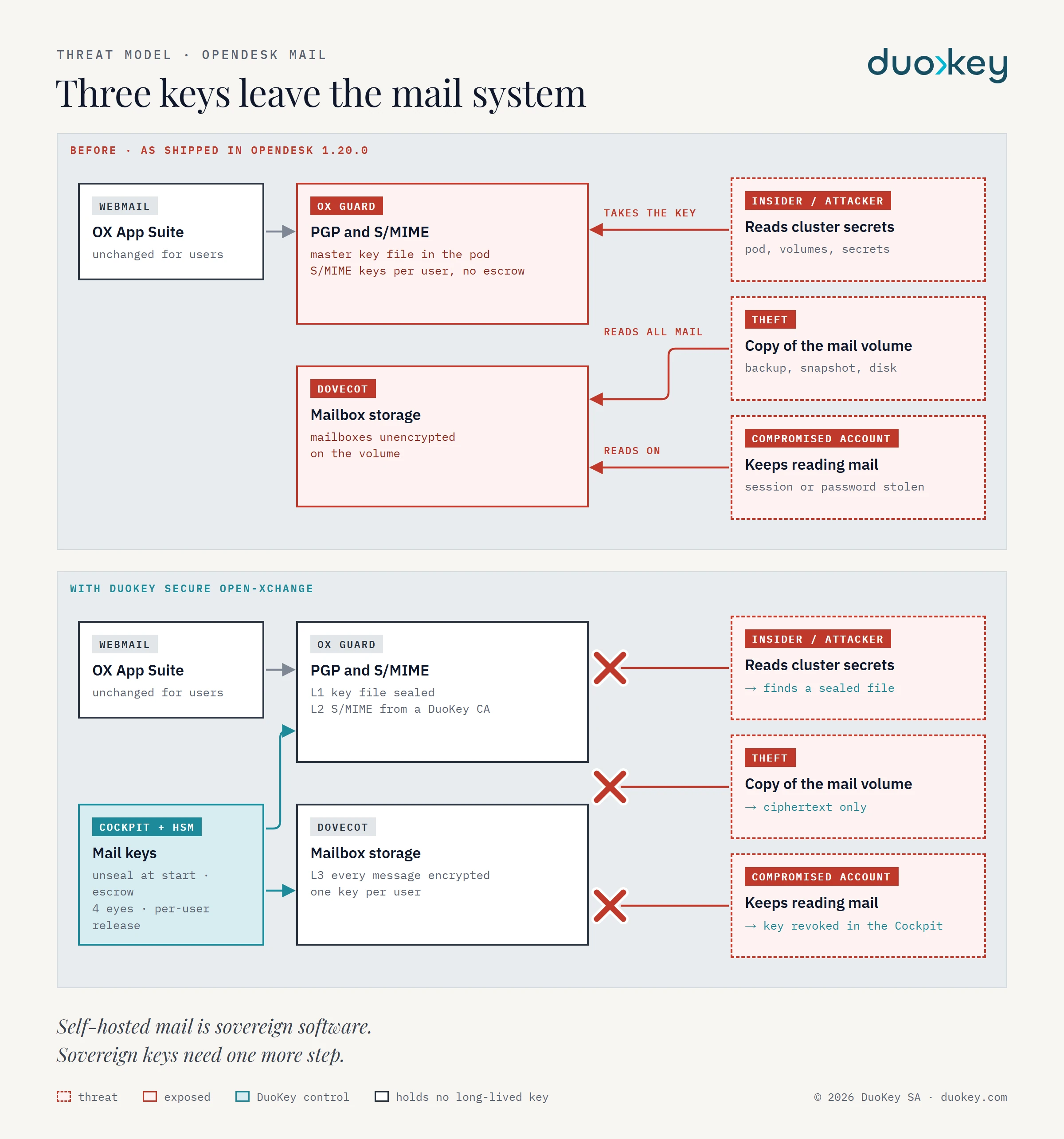
DuoKey Secure Open-Xchange takes the keys out of the mail system, in three levels. We verified all three end to end with openDesk 1.20.0.
- The OX Guard master key is sealed with a key in the DuoKey Cockpit. The cluster holds ciphertext only; at start-up the Cockpit unseals the file into the pod's memory. If the key is disabled in the Cockpit, Guard does not start: closed, not open.
- S/MIME from your PKI. The Cockpit issues the certificates from its own CA and keeps the private keys in escrow under a KEK. Recovery only under dual control: the requester cannot approve, and the approval is used once.
- One key per mailbox. Dovecot encrypts every message as it is stored. The Cockpit releases the user's key sealed with hybrid P-256 and ML-KEM-768 and stores it nowhere; every release and every refusal is in the access journal.
An attacker who copies the mailbox volume gets ciphertext. Whoever reads the cluster's secrets finds the Guard key only in sealed form.
Revoke instead of hope
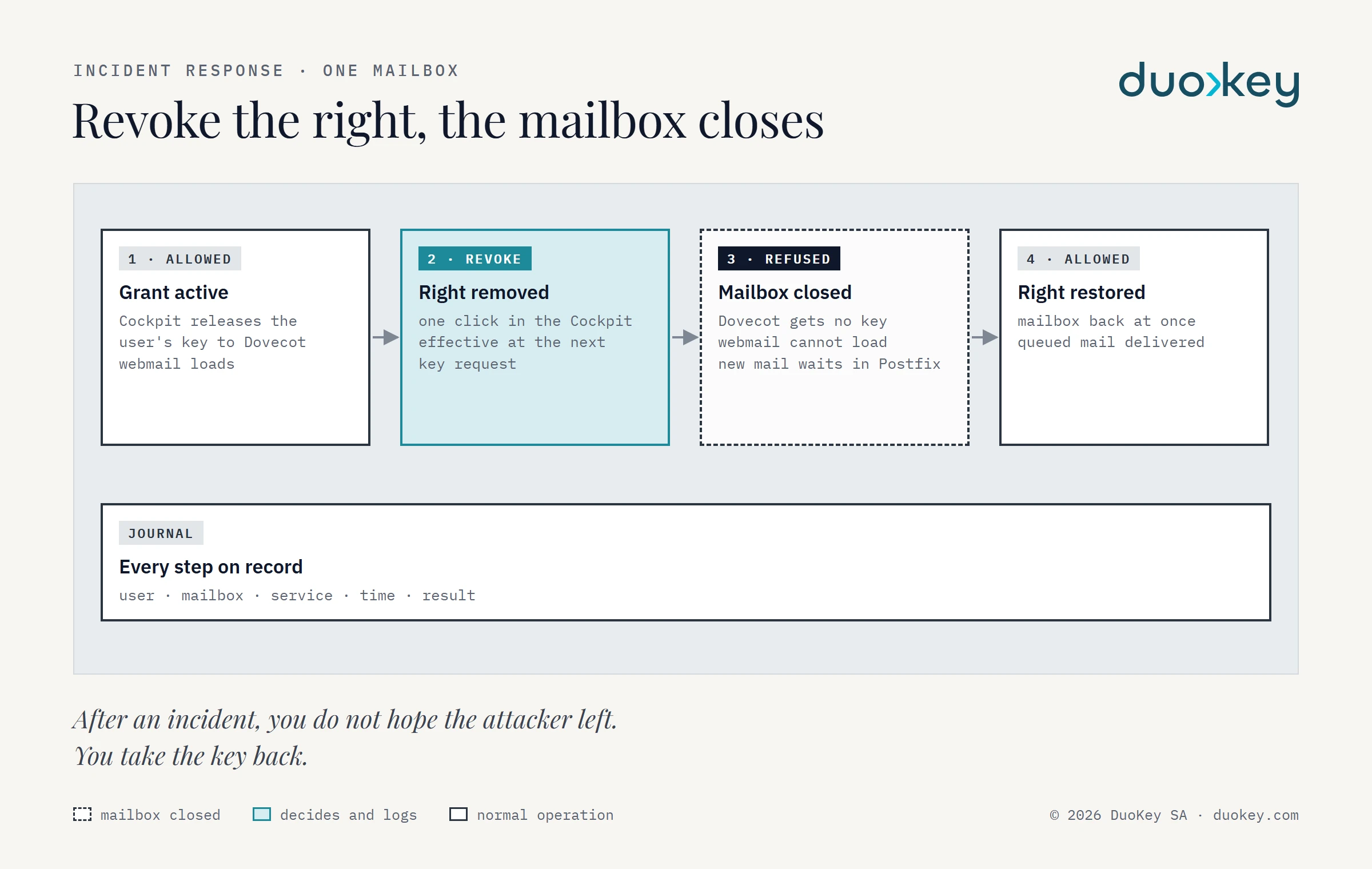
The main difference shows after an incident. If an account or a service becomes suspicious, you revoke the right to the mailbox key in the Cockpit. In our verification, the mailbox then no longer loads, new messages wait in the Postfix queue, and the journal shows the refusal. Restore the right and the mailbox is back at once.
That turns "what was read?" into a question you can answer: the journal shows every release per user, mailbox and service.
Checklist
- Check and update the Java runtimes of Keycloak, OX App Suite and other Java services to the 17 November builds.
- Compare your Dovecot version with Advisory 3/2026 and confirm with your provider which fixes your build includes.
- Check whether mailboxes are encrypted at rest, and where that key lives.
- Find out where the OX Guard master key lives and who can read the cluster's secrets.
- Decide how S/MIME keys are issued, escrowed and recovered, and by whom.
If you run openDesk or OX App Suite, you can test Secure Open-Xchange with us in your own environment, level by level.
Sources
- Tenable, Java4Shell (CVE-2026-114938): OpenJDK RCE Vulnerability FAQ, 17 November 2026, updated 18 November. tenable.com
- Open-Xchange, Dovecot Security Advisory 3/2026, 26 August 2026 (Full Disclosure, 28 August 2026). seclists.org
- openDesk, documentation and source code. opencode.de